

The Centers for Disease Control and Prevention has taken a dramatic step. The agency is ending its long-running monkey research program at its Atlanta headquarters.
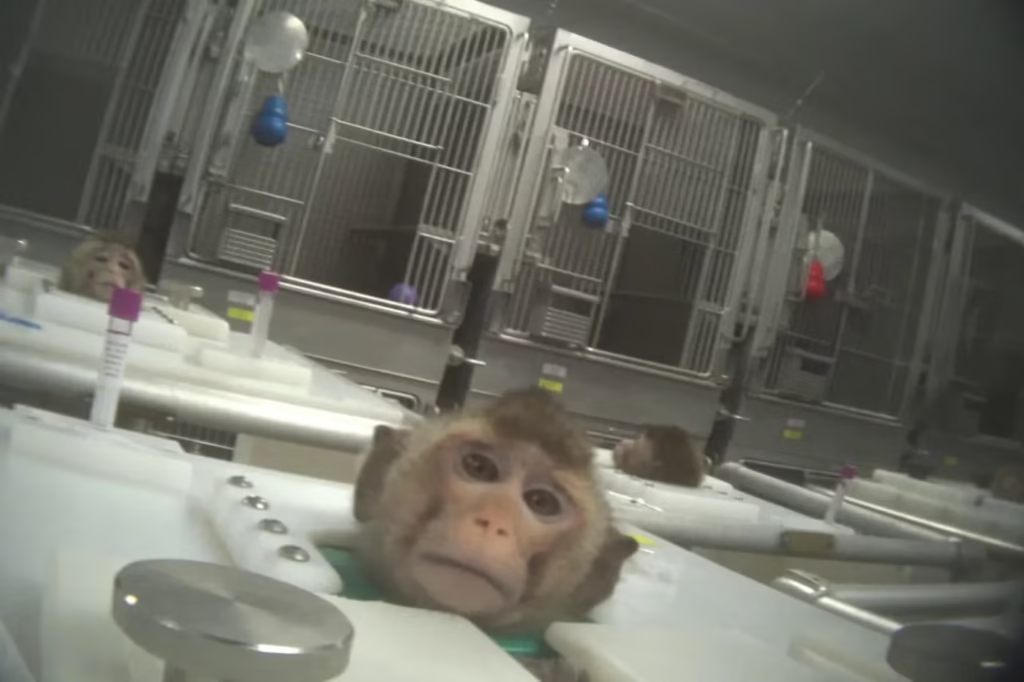
The decision affects about 200 macaques who have spent years inside federal labs. It also marks one of the most significant shifts in US infectious-disease research in recent memory.
Why Monkeys Were Used
For decades, the CDC used rhesus and pig-tailed macaques to study viruses like HIV and hepatitis. These animals were chosen because their biology mirrors ours in key ways. Scientists often turned to them when mice or cell cultures could not provide reliable answers.
That history makes the shutdown even more striking. Many inside the agency did not expect such a fast and sweeping order.
The CDC’s Directive
According to staff, the CDC instructed researchers to halt all monkey studies by the end of the year. Ongoing projects must be wrapped up or stopped entirely.
A spokesperson said the move supports the “replacement, reduction, and refinement” principles that guide animal research ethics. These principles encourage scientists to use non-animal models whenever possible. The shift also aligns with a wider push inside the Department of Health and Human Services to reduce primate experimentation.

Uncertainty Over the Monkeys’ Fate
What happens next is still unclear. And that uncertainty centers on the monkeys themselves. The CDC has not publicly shared a plan for the roughly 200 animals now caught in limbo. Some researchers fear the program’s sudden closure could lead to outcomes no one wants to see.
They worry about the fate of animals who have already endured years of invasive studies. Animal-welfare groups are demanding that the macaques be sent to sanctuaries, not shuffled to other laboratories or euthanized. But the agency has made no commitments.
Mixed Reaction From Scientists
Scientists outside the CDC also have mixed reactions. Some warn that ending primate research may slow progress on diseases that still rely on macaque models. They point out that certain immune responses cannot yet be reproduced with organ-on-chip systems or computer simulations.
Others welcome the decision. They see it as a chance to push the government toward safer and more human-relevant research technology. They argue that modern tools can often produce clearer and faster results without causing animal suffering.
A Larger Shift in US Research
Animal-rights groups have praised the news as historic. They say it reflects a growing recognition that intelligent, social animals do not belong in laboratories. They also point to a broader trend. Other US agencies have already scaled back primate research in recent years.
As alternatives evolve, more institutions are reconsidering their reliance on nonhuman animals.
Looking Ahead
The CDC’s decision could reshape infectious-disease research for years. But it also leaves urgent questions unanswered. The biggest one concerns the animals who made these studies possible. Their future now depends on what the agency chooses to do next.