
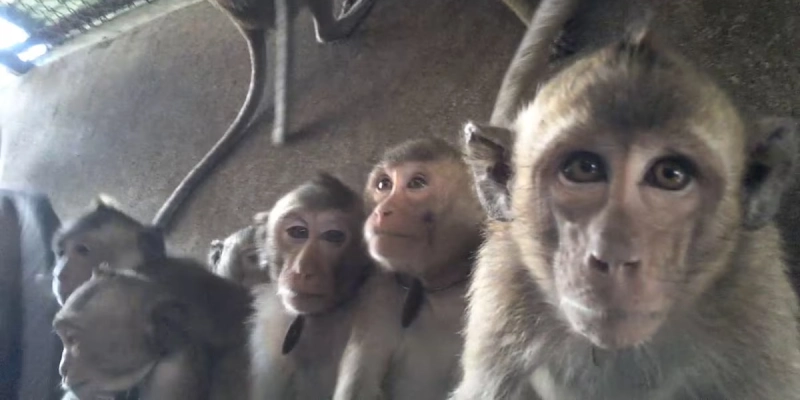
The United States may be on the edge of a major change in how animals are used in scientific research. The Department of Health and Human Services is exploring a possible ban on importing monkeys for laboratory experiments.
The idea was publicly discussed by HHS Secretary Robert F. Kennedy Jr. and has drawn national attention from both animal advocates and the research community.
Every year, tens of thousands of monkeys are imported into the US for biomedical testing. Most are used in invasive experiments. Many spend their entire lives in confinement. These animals are often bred overseas and shipped long distances under stressful conditions.
.@SecKennedy: “The primate centers have a profit motive…Even when it doesn’t make any sense to do these kinds of experiments…they don’t really want to switch, and we need to challenge that inertia.” pic.twitter.com/azWm3WYQSG
— HHS Rapid Response (@HHSResponse) December 21, 2025
Injuries and deaths during transport are well documented. Once inside laboratories, the suffering continues.
The proposal being explored would halt future monkey imports. It would also examine the possibility of converting the country’s national primate research centers into sanctuaries.
These centers currently house thousands of monkeys used for testing funded by federal agencies. The proposed shift would prioritize lifelong care over experimentation for animals already in the system.
Public health concerns are a key factor in the discussion. Imported monkeys can carry serious infectious diseases, including tuberculosis and herpes B. There have been past cases where lab workers were exposed.
.@SecKennedy: “The badge of a really humane nation is the way that it takes care of its animals.” pic.twitter.com/1MYHdKQ0At
— HHS Rapid Response (@HHSResponse) December 21, 2025
Some infections proved fatal. Critics argue that importing animals with known zoonotic risks creates unnecessary danger for workers and surrounding communities.
There is also growing debate about the scientific value of primate experiments. Many treatments that show promise in monkey trials fail during human clinical testing. The failure rate is high.
This has raised questions about reliability and cost. Researchers are increasingly turning to alternatives that better reflect human biology.
New methods are advancing quickly. Human cell-based models are improving. Organ-on-chip systems are being adopted. Artificial intelligence is now used to predict drug responses. These tools reduce the need for animal testing and often deliver faster, more relevant results.
Animal protection groups have welcomed the announcement. They describe it as a long-overdue step toward ethical science. Ending imports, they argue, would save thousands of animals each year and reduce pressure on primate populations abroad.
The proposal is still under review. No final policy has been announced. Industry resistance is expected. But the discussion itself marks a significant moment. If the US moves forward, it could reshape research standards and signal a broader shift toward humane and human-focused science.